
 Version française
You are here: Home > Heritage > Renaissance mansions
Renaissance mansions
Hotel des Echevins (The Aldermen's house)
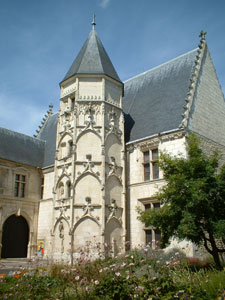 This former Town Hall, which is typical of those of northern France, was built against the Gallo-Roman wall at the end of the 15th century.
On the ground floor, the rectangular main building comprises the great hall with a monumental fireplace and the arched, stone Council Chamber.
An external spiral staircase leads to the upper floors. Its elaborate decoration was inspired by that of Jacques Coeur's Palace : equilateral arches, pinnacles, sculptures of people at false windows.
A side wing, inspired by treatises on Renaissance architecture, was added to the main building in the 17th century.
The Aldermen's House has been restored and is now a museum which houses the works of the painter Maurice Estève which have been donated to the City.
Hotel Lallemant
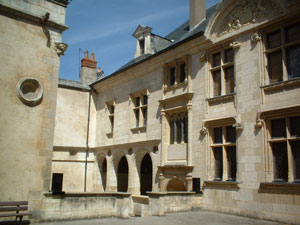 This mansion, which dates from around the year 1500, is an example of the early French Renaissance style.
It was built by the Lallemant brothers who were in charge of certain municipal and financial affairs and who were closely linked to the artistic circles of the time.
It is built on the Gallo-Roman wall, which explains the sloping passageway linking the upper courtyard (where the main entrance was situated) and the lower courtyard (now the visitors' entrance) and leading to the inside spiral staircase.
The Renaissance ornamentation is concentrated around the windows and turrets in the upper courtyard and its beauty leads us to suppose that it could be the work of an Italian artist.
Inside, the oratory has a remarkable coffered ceiling depicting alchemic symbols.
Now the Museum of Decorative Arts, the Hôtel Lallemant houses collections of furniture, paintings, tapestries and objets d'art from the 15th to the 17th century.
Hotel Cujas
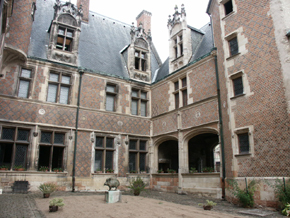 This mansion was built at the beginning of the 16th century for an Italian merchant who had settled in Bourges.
It was later purchased by Jacques Cujas, a lawyer and professor at the University of Law in Bourges, who gave it its name.
Its design and layout are typical of that period but the brick and diamond-shaped lattice stonework facing of the courtyard is unusual in this area.
It is decorated in the Gothic style.
Just the shells under the windows, the medallions and the main doorway are early French Renaissance.
Property of the City of Bourges since 1878, the Hôtel Cujas now houses the Berry Museum.
Hotel Dieu
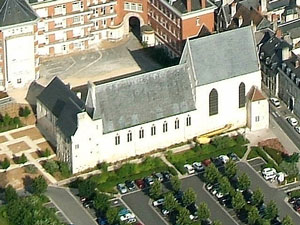 Begun in the 16th century, the Hôtel Dieu of Bourges combines Gothic architecture with a Renaissance décor.
The Gothic ensemble was completed by additions in the 17th century which were the work of celebrated local architect Jean Lejuge, whose typically Classical trademarks were bold rustication, alternating triangular and semi-circular pediments, joggled window casings, and capitals of Roman inspiration.
In time the Hôtel Dieu became the major charitable institution of Bourges, with extensive hospital activities which did not cease until 1994; since 1999 it underwent major restoration.
