
 Version française
You are here: Home > Culture - Leisure > Concert halls
Concert halls
The Auditorium
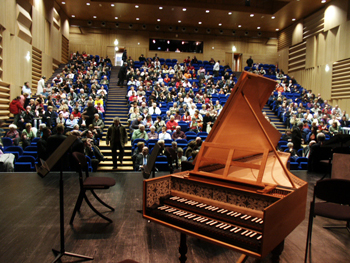 In use since September 2006, the Bourges Auditorium is the flagship of the new National School of Music and Dance. Comprising of 499 seats which are arranged on a gradient in 14 rows, with an extra 4 rows when the orchestra pit is not in use, the last row of armchairs is positioned 19m from the stage, which guarantees superior visual and sound quality.
The design of the ceiling and the walls, not only improves the acoustics, but is intrinsic to the decoration of the room.
The vast 600 m2 reception hall opens out onto the green landscape of the Auron river. Spanning this river, a footbridge gives access to the car park at the “Plateau d' Auron”.
This building has been awarded a label of High Environmental Quality, and is a fine example of construction in terms of heating economies and energy consumption. The Bourges Auditorium is ideally suited for all events where a high quality of sound is required: not only concerts, recitals, operas, but also dance, jazz, world music...
Le Hublot
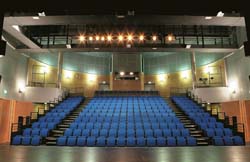 Inaugurated in 2005, Le Hublot is a cultural space comprising of a concert hall and three work shops/studios, managed by the Bourges Cultural Agency.
With a 234 seating capacity (500 when standing), the circular concert hall consists of a vast, totally equipped stage (sound and lighting systems etc).
Theatre technicians are available, offering artists and performers a ‘ready to go' service.
Particular attention has been paid to the acoustics, notably with the installation of wood panelling. Events are managed and provided by the Cultural Agency and available dates are open to local and national clubs and associations.
The three workshops/studios are equipped for theatre, dance and music respectively. A technician is present when each studio is in use.
Jacques Coeur theatre
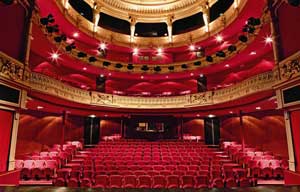 Succeeding an original building begun immediately after the French Revolution, entirely destroyed by fire in 1856, the present Jacques Coeur Theatre was inaugurated in 1860.
Although having been through several necessary updates, it remains an ‘Italian Theatre' with its boxes and ‘gods' etc.
The facades, ceilings, entrance hall, auditorium and corridors were added to the Historic Monuments list on the 5th October 2004.
In 2005, highly trained craftsmen restored the auditorium, from its armchairs to its golden balconies, to its original quality.
With a 350 seating capacity, this intimate spaces benefits from incomparable acoustics. Full of charm and conviviality, the Jacques Coeur Theatre is acclaimed by local clubs and associations and show organisers alike. It welcomes not only music and dance events but conferences, films, plays of course, and also radio programmes (On Radio France for the Printemps Bourges Festival).
