
 Version française
You are here: Home > Heritage > Cathedral
Cathedral
At the end of the 12th century : an avant-garde Cathedral for a new world
A Royal City since the year 1100, Bourges is growing in size and prosperity.
In the upper part of the town, the Great Tower, which is the twin of the keep at the Louvre, is the symbol of Royal Power. The new Gothic Cathedral which is under construction is a hymn to the authority of the Archbishops of Bourges, primates of Aquitaine.
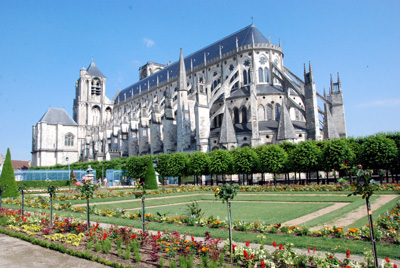 Figurehead of the Capetian domain facing the south of France, St Etienne's Cathedral had to be unique in design. The architectural style chosen by the unknown Master-builder is based on a plan with no transept and plastic effects of great modernity for their time. The Cathedral is still surrounded by the half-timbered houses of the medieval town.
These are the criteria which earned the addition of St Etienne's Cathedral to UNESCO World Heritage sites list in 1992.
The Site
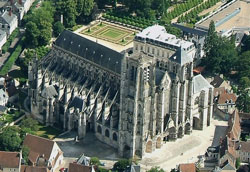 In 1195, with the assistance of the Chapter of canons, Archbishop Henri de Sully decides to rebuild the Cathedral, starting with the chevet, in the new Gothic style.
The choir is erected above a church, wrongly referred to as the " crypt ", which had been built on the moat of the Gallo-Roman wall to gain space.
The architectural features of the whole edifice are already visible in the chevet : the pyramidal composition of the elevation, the audacious double flying buttresses, which are intended to create effects of perspective and harmony of volumes inside the edifice.
In 1199, Archbishop Guillaume de Dangeon, a former Cistercian abbot, succeeds Henri de Sully and plays an important part in the development of the site and in the definition of the iconographical programme : the cathedral as a whole, its carved decorations, the stained glass windows, which are the assertion of religious doctrine against heresy.
Guillaume's death, followed soon after by his canonisation, brings in a flood of donations from the faithful and pilgrims.
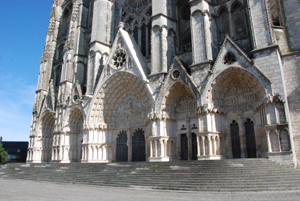 The second stage of construction, including the nave and the west front, is finished around 1230. Five carved portals complete the facade.
The architects who succeeded the first Master-builder maintained the coherence and the apparent simplicity of the programme, the absence of a transept contributing to the effect of unity of space.
The South Tower (known as the Deaf Tower because it has never housed any bells) shows signs of cracks from the 13th century and has to be supported by a huge buttressing pier.
The North Tower collapses in 1506 and is rebuilt to harmonise with the Gothic facade although it comprises certain Renaissance ornaments.
The Light
 A rare array of early 13th century stained glass windows adorns the three levels of the choir and illuminates the stone with a mosaic of coloured light. Bourges is a masterly expression of the pursuit of " lux continua " that accompanied the surge in spirituality of the 12th century.
The play of light and inner volumes commands the conception of the whole.
These books of light illustrate the instruction of the Church : the Christ of the Last Judgement and the Apocalypse, the Blessed Virgin and Saint Etienne are flanked by the trade guilds, parallel scenes from the New and Old Testaments, the life of the Saints and Martyrs, the Archbishops of Bourges, the Prophets and Apostles.
At the end of the 14th century, the window known as " Le Grand Housteau ",which is a gift of Duke John of Berry, gives the finishing touch to the west facade.
In a completely different vein, the side chapels of the 15th and 17th centuries are decorated with windows commissioned by eminent families of Bourges, the best known no doubt being the window of The Annunciation in the Chapel of Jacques Coeur.
The Stone
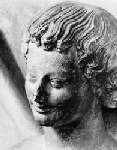 The smile of Saint Michael the Archangel, the smile of the naked youths who have been raised from the dead, and that of the Elect draped in long robes look up to Christ, majestic and welcoming on the tympanum of the Last Judgement, while Hell swarms with demons and creatures in the torments of despair.
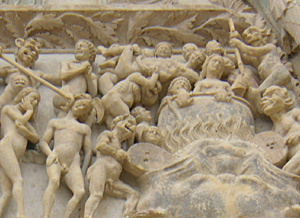 Living humanity is incarnated in the stone of the central portal of the west facade to form a grandiose representation of the Last Judgement with is both realistic and timeless. It is a masterpiece of Gothic sculpture of the 1240s.Carved at the same time, the rood screen is removed in 1757. Fine fragments of it are now on display in the lower church together with the recumbent statue of Duke John of Berry (early 15th century).
The side portals (dating originally from around 1160) display fine examples of Romanesque carvings. The Cathedral is also a museum of sculpture throughout the ages.
The Paintings
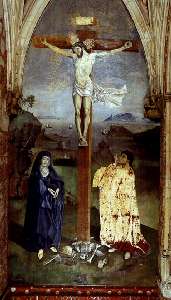 The discovery of emblematic murals (in the sacristy of the Chapter House decorated by Jacques Coeur in honour of Charles VII around 1450) is followed by another less expected and more enigmatic one : the frescoes of the Crucifixion on a seascape background and of the resurrection of Christ in the Chapel of Du Breuil which date from about 1475.
The astronomical clock and clockface representing the signs of the Zodiac, painted by Jean d'Orleans, have been restored. The original mechanism, which is the work of Canon Fusoris (1424) is well-preserved.
